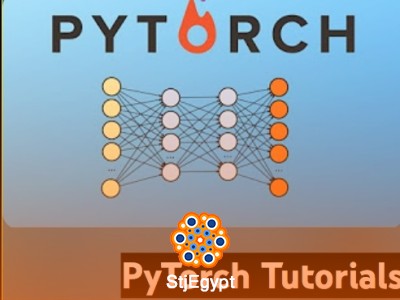

Comprehensive PyTorch Deep Learning Course for Machine Learning and AI Development
This comprehensive PyTorch deep learning course is designed for beginners and intermediate learners who want to master machine learning and artificial intelligence using Python. The course provides a structured learning path starting from environment setup and progressing toward advanced neural network architectures and real-world AI applications.
Learners are introduced to the full workflow of deep learning development, including data handling, model building, training, and deployment. The course focuses on practical implementation to ensure learners gain real-world skills in PyTorch and machine learning.
Environment Setup for Deep Learning Development
Learners begin by setting up a complete deep learning environment using tools such as Anaconda and PyCharm. This ensures a stable and efficient workflow for building and testing machine learning models.
This step is essential for avoiding technical issues and creating a professional development environment suitable for AI projects.
PyTorch Tensors and Core Operations
This section introduces PyTorch tensors in detail, which are the fundamental building blocks of all deep learning models.
Tensor Initialization and Data Handling
Students learn how to create and initialize tensors, which are used to store numerical data in PyTorch. Understanding tensors is essential for working with neural networks.
Mathematical Operations and Tensor Manipulation
The course covers operations such as addition, multiplication, indexing, and reshaping. These operations help learners understand how data is processed inside AI models.
Building and Training Neural Networks
This section focuses on building and training basic neural network models using PyTorch.
Training Workflow and Model Optimization
Learners explore how models are trained using loss functions and optimizers. This includes understanding forward passes, backpropagation, and parameter updates.
Model Evaluation and Performance Improvement
Students learn how to evaluate model accuracy and improve performance using different optimization techniques.
Advanced Deep Learning Architectures
This part of the course introduces advanced neural network architectures used in modern AI systems.
Convolutional Neural Networks (CNNs) for Image Processing
Learners study CNNs and how they are used to process and analyze image data in computer vision tasks.
Recurrent Neural Networks (RNNs) and LSTMs for Sequence Data
The course explains how RNNs and LSTMs are used for sequence data such as text and time series, enabling AI systems to understand sequential patterns.
Bidirectional LSTMs for Advanced Sequence Learning
Students learn how Bidirectional LSTMs improve sequence modeling by processing data in both forward and backward directions.
Transfer Learning and Pretrained Models
This section covers transfer learning techniques, allowing learners to use pre-trained models and fine-tune them for specific tasks.
This approach significantly reduces training time and improves model performance on small datasets.
Custom Dataset Creation for Images and Text
Learners are introduced to creating custom datasets for both image and text data, which is a crucial skill for real-world machine learning applications.
This includes data preprocessing, labeling, and structuring datasets for training deep learning models.
Saving and Loading Trained Models
The course explains how to save trained models and load them later for inference or deployment.
This ensures that trained AI systems can be reused efficiently in real-world applications without retraining from scratch.
Final Learning Outcome
By the end of this course, learners will have strong practical skills in PyTorch and deep learning, enabling them to build advanced AI applications across different domains such as computer vision, NLP, and predictive modeling.