4- بعد الانتهاء تظهر الشهادة في الملف الشخصي الخاص بك
Master PyTorch in one day with a full beginner-friendly course covering tensors, neural networks, training workflows, computer vision, and custom datasets.
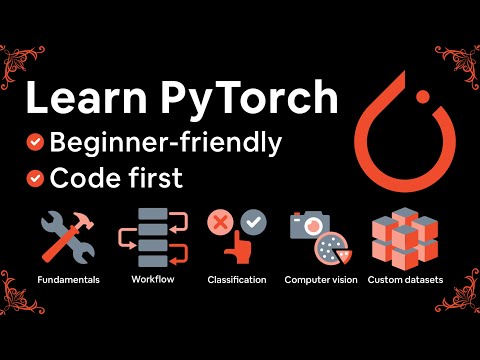
This intensive PyTorch crash course is designed for beginners who want to quickly learn how to build and train deep learning models using Python. The course follows a structured, hands-on approach that takes learners from the absolute basics of deep learning to advanced neural network applications in a single, complete learning path.
Deep learning is a subfield of artificial intelligence that enables computers to learn from large amounts of data and improve their performance without being explicitly programmed. It is based on neural networks that simulate the way the human brain processes information, allowing machines to recognize patterns and make decisions.
Why Deep Learning Matters Today
Deep learning has become one of the most important technologies in the modern world, powering applications such as image recognition, speech processing, autonomous driving, and recommendation systems. Its ability to solve complex problems has made it essential in almost every tech-driven industry.
Role of PyTorch in Modern AI Development
PyTorch is a powerful open-source deep learning framework widely used for building and training neural networks. It provides flexibility, ease of use, and strong support for research and production environments, making it one of the most popular tools in artificial intelligence today.
Why Learn PyTorch for Deep Learning
Benefits of Using PyTorch
PyTorch allows developers to build neural networks efficiently while maintaining full control over the model structure. It is beginner-friendly and widely adopted in both academic research and real-world AI applications.
PyTorch Compared to Other Frameworks
Compared to other frameworks, PyTorch is known for its simplicity, dynamic computation graph, and ease of debugging, which makes it a preferred choice for developers and researchers in AI.
Real-World Use Cases of PyTorch
PyTorch is used in many industries including healthcare, finance, robotics, and computer vision. It is the backbone of many modern AI systems that require deep learning capabilities.
PyTorch Fundamentals and Tensor Operations
Understanding Tensors in PyTorch
Learners then move into PyTorch fundamentals such as tensors, which are multi-dimensional arrays used to store and manipulate data in deep learning models.
Tensor Operations and Data Manipulation
The course covers tensor operations including mathematical calculations, data types, indexing, reshaping, and other transformations that are essential for preparing data for neural networks.
Working with Data Structures in PyTorch
Students also learn how to organize and manipulate data efficiently, which is a critical step before building and training machine learning models.
Building Machine Learning Workflows
Creating and Preparing Datasets
Next, the course focuses on building real machine learning workflows. Students learn how to create datasets and prepare them properly for training models.
Splitting Data for Training and Testing
Learners are taught how to split data into training and testing sets to ensure models are evaluated correctly and perform well on unseen data.
Building and Training Neural Network Models
Students learn how to build neural networks using PyTorch, define architectures, and train models using real datasets.
Loss Functions and Optimizers Explained
The course explains how to define loss functions and optimizers, which are essential components that help models learn and improve over time.
Training and Testing Loops Implementation
Learners implement full training and testing loops, understanding how models learn from data and how performance is evaluated during training.
Neural Network Classification Concepts
Non-Linearity in Neural Networks
A major section covers neural network classification and introduces key concepts such as non-linearity, which allows models to learn complex patterns in data.
Logits and Model Outputs
Students learn about logits, which represent raw outputs from neural networks before applying activation functions for classification.
Multi-Class Classification Systems
The course also explains multi-class classification, where models are trained to distinguish between more than two categories of data.
Computer Vision and CNN Models
Introduction to Computer Vision
After that, learners dive into computer vision, where they explore how machines interpret and analyze images.
Convolutional Neural Networks (CNNs)
Students build convolutional neural networks (CNNs), which are specialized models designed for image recognition and processing tasks.
DataLoaders and Image Dataset Handling
The course teaches how to work with DataLoaders to efficiently manage and process large image datasets.
Model Evaluation Using Confusion Matrices
Learners evaluate model performance using confusion matrices, which provide detailed insights into classification accuracy.
Advanced Dataset Handling and Optimization
Custom Dataset Creation
The course also teaches custom dataset creation, allowing learners to work with their own real-world data.
Data Augmentation Techniques
Data augmentation is introduced to improve model performance by increasing dataset diversity and reducing overfitting.
Improving Model Performance)
Students learn various techniques to optimize and improve the accuracy of deep learning models.
Real-World AI Applications
End-to-End Deep Learning Systems
By the end, students will have the ability to build complete deep learning systems using PyTorch confidently and efficiently.
Industry Applications of AI Models
The course also prepares learners for real-world AI projects across industries such as healthcare, finance, and computer vision.
Final Outcomes and Skill
Skills Gained from This Course
Learners gain practical skills in building, training, and evaluating deep learning models using PyTorch.
Career Opportunities in AI and Machine Learning
By the end of the course, students are prepared for careers in artificial intelligence, machine learning, and data science.